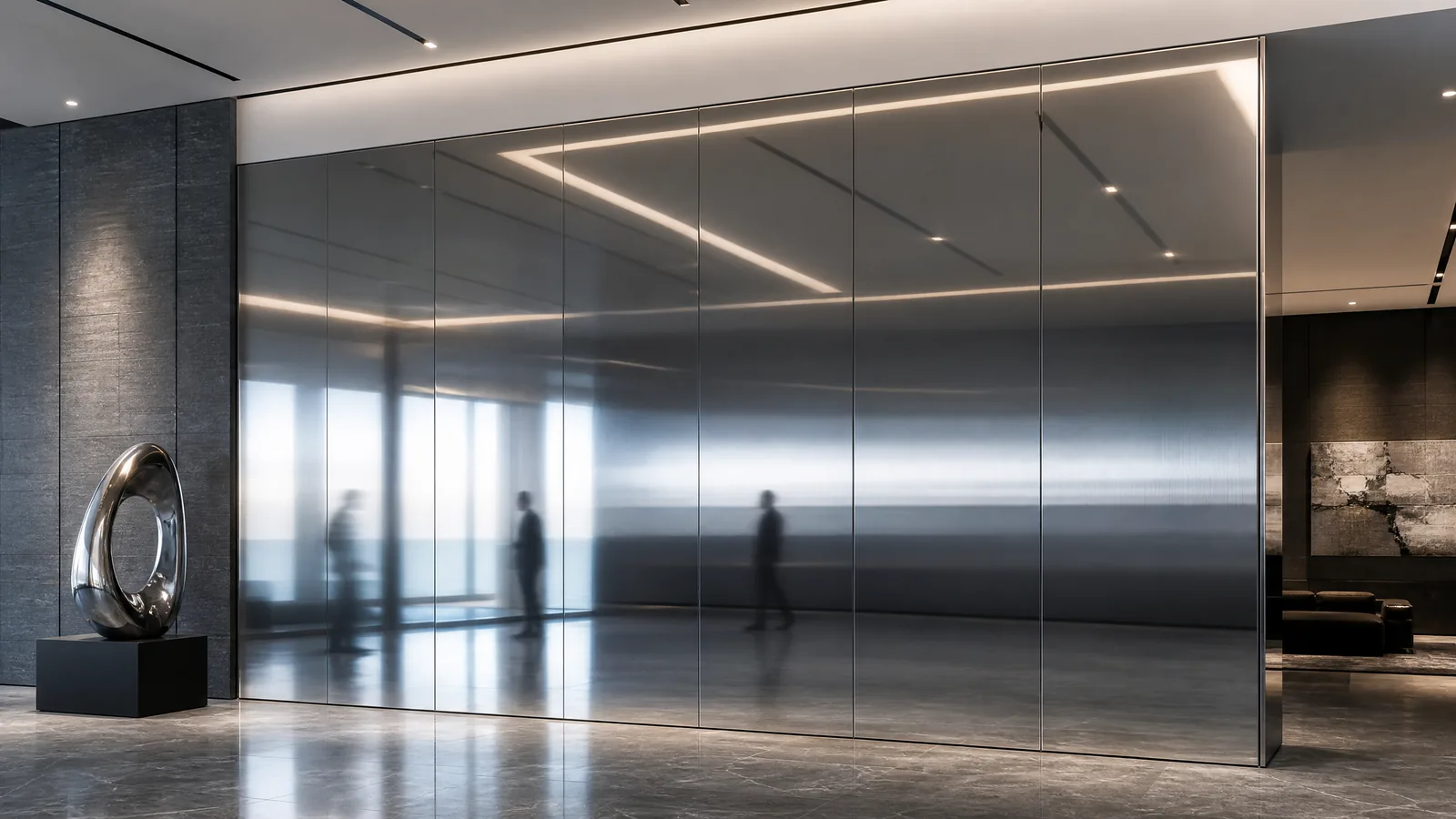
To achieve a true architectural mirror, specify No. 8 (8K/BA) stainless steel with a defect-free polish, protective film, appropriate alloy for the environment (commonly 304 interior, 316 exterior/coastal), and tight flatness/consistency controls. Define fabrication, panelization, and cleaning requirements in your RFQ to ensure uniform reflections and efficient installation.
Understanding No. 8 (8K/BA) Mirror Stainless Steel
No. 8 mirror stainless steel (often called 8K) is a highly reflective surface achieved by progressive mechanical polishing and buffing that removes surface irregularities until the sheet behaves as a true mirror. A visually similar appearance can also be produced by bright annealing (BA), which is heat treatment in a controlled atmosphere that preserves a bright, smooth surface. In architectural practice, No. 8 and BA are sometimes used together on a project when a uniform mirror effect is required.
Typical process steps for No. 8 mirror sheets include:
- Coarse grinding to remove mill scale and surface defects
- Intermediate polishing with increasingly fine abrasives
- Final buffing to bring the surface to a high-gloss mirror
- Application of a removable protective PE/PVC film to safeguard the finish during fabrication and installation
Because the mirror finish reflects its surroundings, uniformity of polish, flatness and color tone across batches is essential for clean, continuous reflections on feature walls, columns and ceilings.
Specification and Buying Options for Architectural Projects
Define the finish clearly and list project-critical options in your purchase order or tender. The table below summarizes typical decision points for mirror sheets and related components.
| Specification item | Buyer guidance |
|---|---|
| Finish designation | No. 8 (8K mirror) and/or BA. State if both are acceptable or if one is mandatory for visual continuity. |
| Base grade (alloy) | Common architectural choices include 304 (interiors/general) and 316 (exterior/coastal). 201 may be used for designated interior decorative zones. Align with environment and performance; see stainless steel grade comparison. |
| Surface color | Natural stainless (silver) or specify PVD color coating if a tinted mirror is required. See PVD color coating options. |
| Thickness, width, length | State exact dimensions or cut-to-size panel schedule. Include tolerances and any panelization plan to control joint layout. |
| Flatness and visual quality | Call for architectural flatness suitable for mirror reflections. Request batch consistency and defect-free surfaces suitable for eye-level viewing. |
| Protective film | Specify PE/PVC film type (one or two sides), thickness category, and removal direction marks if needed for site sequencing. |
| Edges | Slit or mill edge for sheets; deburred edges for components. Indicate if edges will remain visible and require finishing/polishing. |
| Fabrication | List processes (laser cutting, bending, welding, notching). State which faces are “exposed” after assembly. For assemblies, consider OEM custom fabrication. |
| Back side | Define back finish (e.g., 2B, painted backer, sound-absorbing layer) if relevant to the assembly. |
| Coatings | Anti-fingerprint (clear) topcoat is optional for high-touch areas; confirm appearance expectations before approval. |
| Standards and inspection | State applicable dimensional and material standards and the required inspection criteria for visual quality. For general resources, see World Stainless. |
| Packaging | Request export-ready protection for mirror surfaces (interleaves, corner guards, and crating) appropriate to the shipment mode. |
Applications and Design Considerations
No. 8 mirror stainless is specified where light, depth and premium visual impact are desired. Consider these application notes:
Feature walls, columns and ceilings
Continuous reflections demand flat substrates and controlled joint alignment. Mock up typical panel bays to validate reflection quality and glare management under final lighting conditions.
Elevator interiors and cabs
Mirror stainless can visually expand compact spaces. To manage touch marks, combine mirror panels with hairline or No.4 panels at hand height, or specify an anti-fingerprint topcoat on selected zones.
Retail, hospitality and public lobbies
Mirror elements amplify light and elevate brand ambience. Design panels with removable access zones for maintenance, and ensure cleaning paths and equipment selection are part of facility protocols.
Canopies and sheltered exteriors
For outdoor exposure, select the appropriate grade and detail for drainage, isolation from dissimilar metals, and access for periodic washing. Edge sealing and concealed fixings help maintain the pristine appearance.
Selecting Between No. 8, Brushed and PVD Color Finishes
Many projects blend finishes for visual hierarchy and practical durability. Use the comparison below to position No. 8 mirror among common decorative options:
| Finish type | Appearance | Touch mark visibility | Typical uses |
|---|---|---|---|
| No. 8 (8K) mirror | Highly reflective, true mirror | High | Feature walls, ceilings, column cladding, statement elements |
| Brushed (No.4/Hairline) | Directional satin with visible grain | Lower than mirror | High-touch zones, elevator doors/walls, counters |
| PVD color mirror/satin | Colored tone over mirror or brushed base | Medium | Accents, brand features, decorative hardware |
| Anti-fingerprint topcoat | Clear coating over mirror or brushed | Lower than uncoated | Doors, handles, wayfinding zones with frequent contact |
Explore color options on our PVD color coating page, and combine with mirror or hairline surfaces to balance impact and maintenance.
Fabrication, Handling and On‑Site Protection
Mirror stainless will reflect every detail—good or bad—so protect the surface from first cut to final clean:
- Use non-abrasive tooling and keep dedicated stainless work areas to avoid ferrous contamination.
- Prefer laser or fine plasma for cutting; deburr and protect edges that remain visible.
- Plan bends and folds so the protected (mirror) face remains unharmed; use clean, padded tooling.
- Control heat input for any welding near finished faces; refinishing mirror areas in situ is complex.
- Keep the protective film intact through installation; remove only after adjacent trades are complete.
- Isolate from carbon steel fixings or use appropriate separation to prevent rust staining.
- Allow for thermal movement with properly designed joints in large-format cladding.
Cleaning and Maintenance of Mirror Finishes
Set a routine matched to traffic and location. Use pH‑neutral cleaners and soft, non-abrasive cloths. Wipe in a consistent direction to minimize swirl marks. Avoid chlorides, bleach and abrasive pads. For persistent marks, use cleaners intended for stainless steel and test on an inconspicuous area first. Establish a maintenance log for prominent, eye-level mirrors to keep the aesthetic consistent across zones.
What to Include in Your RFQ or Tender
Complete, unambiguous specifications reduce rework and deliver uniform reflections. Include:
- Finish: No. 8 (8K) mirror and/or BA; acceptable variation and matching requirements
- Alloy/grade and environment of use (interior, exterior, coastal, poolside, etc.)
- Dimensions, tolerances, panelization drawings and joint layout
- Flatness and visual inspection criteria for eye-level viewing
- Protective film type and removal sequence
- Fabrication steps, exposed faces, and edge finishing requirements
- Back side requirements (finish, backing materials, acoustics)
- Optional PVD color or anti-fingerprint coating where applicable
- Applicable material/dimensional standards and acceptance criteria
- Packaging method suitable for transport and site handling
- Quantity by item, timeline, delivery destination and any staging needs
For engineered assemblies or value-added processing, see our OEM custom fabrication capability and share drawings for a coordinated proposal.
Mirror 8K Supply from WJH Stainless Steel
WJH Stainless Steel (Foshan Wanjiahong Stainless Steel Co., Ltd.), founded in 1996, provides a one‑stop route from decorative stainless steel sheets and tubes to custom fabrication. Our capabilities include mirror 8K, hairline/No.4, PVD color, etched, embossed and anti‑fingerprint finishes, plus project fabrication support. Headquartered in Foshan, Guangdong with a production base in Taishan, Guangdong exceeding 100,000 square metres and 600+ employees, WJH operates certified management systems to ISO 9001, ISO 14001 and ISO 45001. We have experience supplying large architectural projects. Explore the dedicated product page for mirror 8K stainless steel sheets, view selected project applications, or browse the wider decorative stainless portfolio.
Frequently Asked Questions
Is No. 8 the same as BA?
No. 8 is a mechanically polished mirror; BA (bright annealed) is produced by heat treatment in a controlled atmosphere. Both are highly reflective. Project teams sometimes accept either if the visual match meets mock‑up approval.
Will mirror stainless show fingerprints?
Yes. Mirror is the most touch‑sensitive finish. For hand‑contact zones, use hairline/No.4 or add an anti‑fingerprint topcoat, and reserve mirror for less‑touched feature areas. See hairline stainless steel for alternatives.
Can mirror finish be used outdoors?
Yes, with appropriate grade selection and periodic cleaning. 316 is commonly chosen for marine or aggressive environments; 304 suits many sheltered exteriors. Design for drainage and access to wash surfaces.
How do we avoid panel mismatch and distortion?
Specify batch consistency, architectural flatness, and mock‑up approval. Keep fabrication heat away from finished faces, maintain the protective film, and use the same source and process route for all visible panels.
What sheet sizes are available?
Availability varies by mill and service center. State exact cut sizes or a panel schedule in your RFQ. For complex parts or assemblies, share drawings via our custom fabrication channel.
Ready to move forward? Send your grade, size list or drawings, finish (No. 8/8K or BA), quantity, delivery destination and any coating or fabrication needs. Our team will review and respond. Contact us at WJH Stainless Steel.