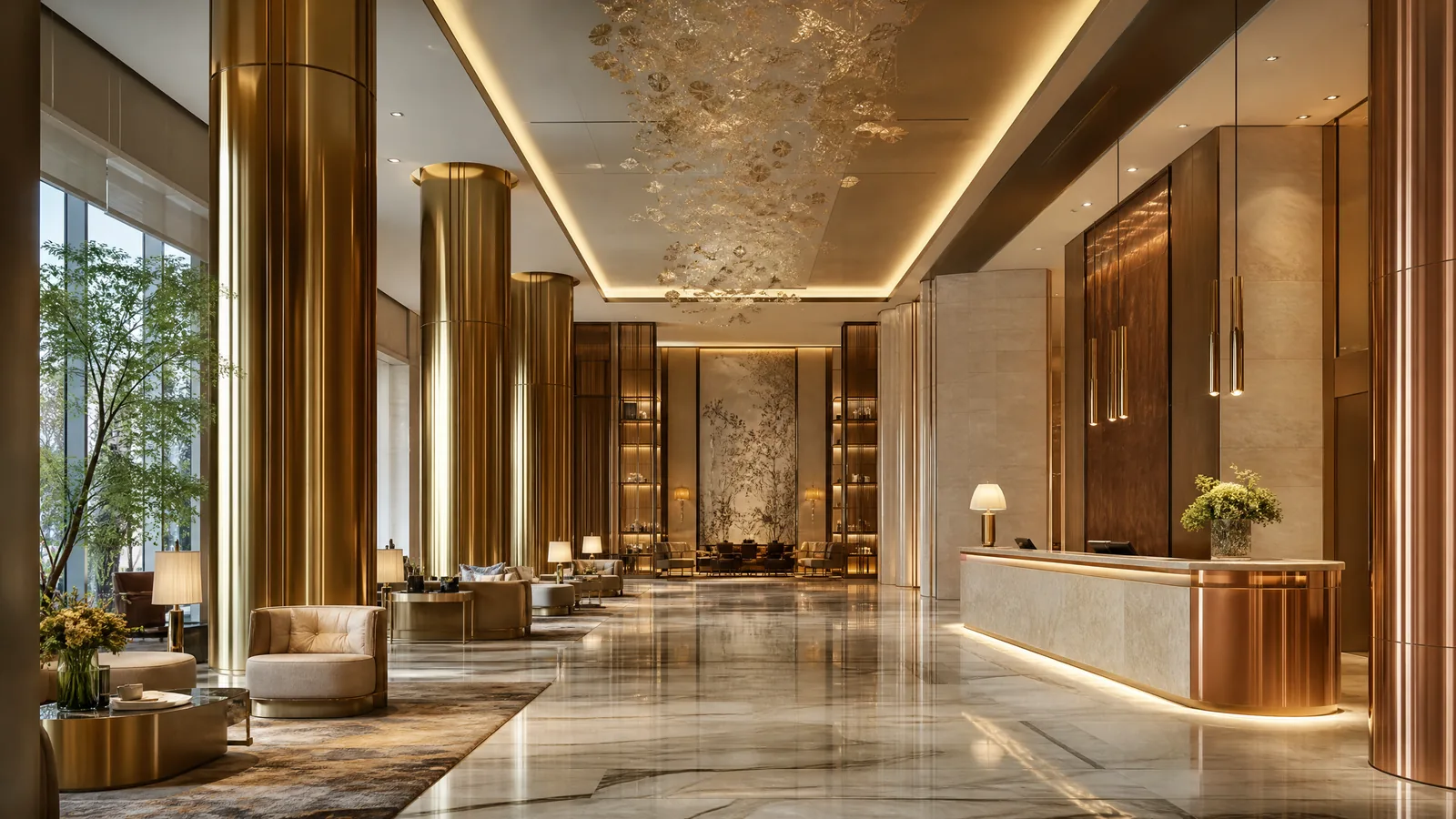
For hotel lobbies, select finishes by touch level and lighting: mirror 8K for features, hairline/No.4 for high-traffic areas, PVD for color accents, and anti-fingerprint where guests touch. Specify grade (304 interior, 316 near chlorides), require batch-controlled samples, approve shop drawings early, and align fabrication, installation, and maintenance plans from day one.
Finishes that perform in hotel lobbies
Decorative stainless steel offers a broad design vocabulary with the durability hotels demand. Match the finish to guest touch points, ambient lighting, and the desired visual hierarchy of the lobby.
Mirror 8K for feature impact
High-reflective mirror stainless steel visually enlarges the lobby and intensifies lighting effects. Use it to highlight feature walls, ceiling canopies, artwork surrounds, and column cladding where reflection is part of the concept. For specification, reference mirror 8K stainless steel sheets and request controlled samples for the target reflectivity and tone. For frequent-touch zones, pair mirror accents with adjacent satin or anti-fingerprint surfaces to manage smudging.
Hairline/No.4 for high-traffic durability
Brushed (No.4) and hairline stainless steel provide a refined, directional texture that diffuses light and disguises minor marks. These finishes are suitable for reception desks, elevator interiors, door frames, trims, and back-of-house interfaces where regular cleaning is expected. See WJH’s hairline stainless steel options for linear and cross-brushed aesthetics.
PVD color for warmth and brand tone
Physical Vapor Deposition (PVD) color brings stable, metallic hues—commonly gold, bronze, champagne, black, and rose tones—without paint layers. PVD is widely specified in Middle Eastern and Southeast Asian hospitality for warm luxury accents on trims, screens, and elevator doors. Explore PVD color coating on stainless steel when you need consistent palette control across large areas.
Embossed and etched textures for depth
Embossed and etched stainless steel introduce tactile depth, reduce perceived wear in busy zones, and control reflectivity for cameras and lighting. Patterned panels are effective in elevator cabs, corridor transitions, and feature backdrops, and can be combined with PVD coloring for bespoke effects.
Anti-fingerprint (AFP) for touch-heavy zones
Anti-fingerprint treatment reduces oil adhesion, making counters, push plates, handrails, and lift button surrounds easier to keep clean. It is often paired with hairline or satin textures to balance elegance and practicality in guest-facing surfaces.
Grades and corrosion considerations
For interior lobby applications away from chlorides, austenitic 304 is commonly specified. In coastal environments, near pools, spas, or kitchens where chlorides and moisture may be present, consider 316 or the grade recommended by the project’s corrosion study. For a quick overview of widely used grades and designations, see WJH’s stainless steel grade comparison. General guidance on stainless steel selection is also available from the Nickel Institute.
Specify the finish and color together with the grade to avoid mismatched appearance across different components. When combining mirror, satin, and PVD in the same sightline, request coordinated samples from the same production batch to confirm tone harmony.
Fabrication and detailing for a premium result
High-visibility lobby metalwork relies on disciplined fabrication. Align the design intent with practical jointing, support, and access from the earliest drawings.
Substrates, frames and backing
Decorative skins typically mount to stable substrates or metal frames. For linear features and handrails, reference stainless steel tubes to integrate structural needs with finish continuity. Define backing materials, stiffness requirements, and permissible deflection at the outset to control panel flatness under lobby lighting.
Edges and joints
Agree edge treatments—hemmed returns, folded corners, or trims—to protect high-touch edges and reduce read-through. Use consistent joint widths and align them to stone or timber datum lines. For long runs, allow for thermal movement to avoid distortion under temperature swings.
Fixing methods and access
Choose concealed mechanical fixings or adhesive systems appropriate to the substrate and service environment. Secure access strategies for MEP interfaces behind feature panels, ensuring removable sections are detailed to preserve sightlines when reinstalled.
Tolerance and lighting checks
Polished and PVD finishes magnify irregularities. Define flatness and gap tolerances in the drawings and confirm them with a site mockup under representative lighting before full production.
Sample approval, mockups and shop drawings
In hospitality projects, finish control and coordinated drawings prevent rework and delays. Lock these items before production release:
- Master samples and batch control – Approve labeled master samples for each finish and color. Require matching from the same batch for all visible areas.
- Project-specific mockups – Build an on-site or shop mockup that includes joints, edges, and integrated lighting to assess reflections, tone, and maintenance access.
- Shop drawings – Dimension panels to actual site measurements; define joint layout, reveals, backing, fixings, tolerances, and movement joints. Coordinate all penetrations with MEP.
- Protection and logistics – Specify protective film during fabrication and transport, and protection-on-site until handover.
WJH provides one-stop support—from decorative sheets and tubes to OEM custom fabrication—to streamline submittals and transitions from sample to production.
Installation planning and maintenance
Successful lobby installations combine careful handling, clean environments, and a clear housekeeping plan. Protect finished surfaces during adjacent trade work and remove debris before unmasking. For routine care, use non-abrasive cloths with mild detergents compatible with stainless steel finishes; avoid cleaners that could leave residues on mirror or PVD surfaces. Anti-fingerprint treatments can reduce visible smudging on counters and door hardware. For general information on stainless steel care principles, see guidance provided by international standards bodies such as ISO and industry associations.
Quick selection table for common lobby elements
Use the table below to align finish intent with practical performance. Confirm final choices with samples and project mockups.
| Lobby element | Recommended finishes | Typical grade | Fingerprint sensitivity | Notes |
|---|---|---|---|---|
| Feature wall / ceiling canopies | Mirror 8K; PVD colored mirror; selective etched/embossed accents | Usually 304 interior; consider 316 near chlorides | High for pure mirror; lower with textures | Control reflections with lighting mockups; align joints to patterns |
| Reception desk cladding | Hairline/No.4; AFP-treated satin; PVD champagne/bronze trims | 304 interior | Low to medium depending on AFP | Reinforce corners; define access panels and cable pass-throughs |
| Elevator doors & interiors | PVD gold/bronze/black; hairline; embossed patterns | 304 interior; align with OEM requirements | Medium; textures help | Coordinate with elevator manufacturer for clearances and adhesives |
| Columns and trims | Mirror 8K bands; hairline fields; PVD colored accents | 304 interior | Medium to high for mirror bands | Allow for movement joints; use replaceable base trims |
| Handrails & screens | Hairline; AFP-treated satin; PVD color where branding requires | 304 interior; consider 316 near pools | Low to medium | Specify tube sizes and radii; confirm comfortable touch temperature under lighting |
What to include in your RFQ or project spec
Clear, complete RFQs speed pricing and reduce resubmittals. Include:
- Application and location per item (e.g., reception desk front, column C1-C8, elevator door skins)
- Grade and finish for each component (e.g., 304 hairline; 304 PVD bronze; mirror 8K)
- Color targets for PVD, including sample numbers or approved control samples
- Panel sizes and thickness per drawing; edge conditions and visible joint widths
- Substrate/backing requirements and fixing method preferences
- Tolerance expectations and flatness criteria for reflective surfaces
- Mockup scope, sample quantities, and packaging/protection requirements
- Related standards or brand guidelines to follow
- Required documentation (material certificates, finish data, MSDS where applicable)
- Project schedule milestones for sampling, mockup, production, and site delivery windows
If you are at concept stage, WJH can provide finish boards, feasibility input, and value-engineering options across mirror, hairline/No.4, PVD color, etched, embossed, and anti-fingerprint solutions.
Why teams choose WJH for hospitality metalwork
Foshan Wanjiahong Stainless Steel Co., Ltd. (WJH Stainless Steel) was founded in 1996, with headquarters in Foshan and a production base in Taishan, Guangdong. The production base exceeds 100,000 square metres and employs more than 600 people. WJH operates under ISO 9001, ISO 14001 and ISO 45001 certifications and supports hospitality projects with one-stop capability—from decorative stainless steel sheets and tubes to custom fabrication.
Capabilities cover mirror 8K, hairline/No.4, PVD color, etched, embossed, and anti-fingerprint finishes, plus OEM fabrication and project coordination. WJH has experience supplying large architectural projects and can align samples, documentation, and drawings to the standards required in international hospitality work. Explore our product range at WJH Products or review our OEM custom fabrication service for engineered components.
Frequently Asked Questions
Which stainless steel finish is most practical for lobby high-touch areas?
Hairline/No.4 and anti-fingerprint satin finishes are preferred for touch-heavy locations because they better disguise smudges and minor wear while maintaining a premium appearance.
When should we specify 316 instead of 304 in a hotel lobby?
Use 316 where chlorides or moisture are present—near entrances exposed to sea air, pools, spas, or service zones—subject to the project’s corrosion assessment.
Can WJH support custom colors and patterns?
Yes. WJH provides PVD color matching and can combine color with etched or embossed textures. Submit target samples or color references for development and approval.
How do we control consistency across large lobby areas?
Approve master samples, request batch-controlled production for visible zones, and build a representative mockup under project lighting before releasing mass fabrication.
Does WJH provide shop drawings and installation guidance?
WJH supports projects with technical documentation and coordination. Provide drawings and site constraints to receive practical recommendations for joints, fixings, tolerances, and protection.
Ready to move forward? Share your grade, size, finish, quantity, destination, and drawings to receive technical input and a detailed offer. Contact us via the WJH contact page.