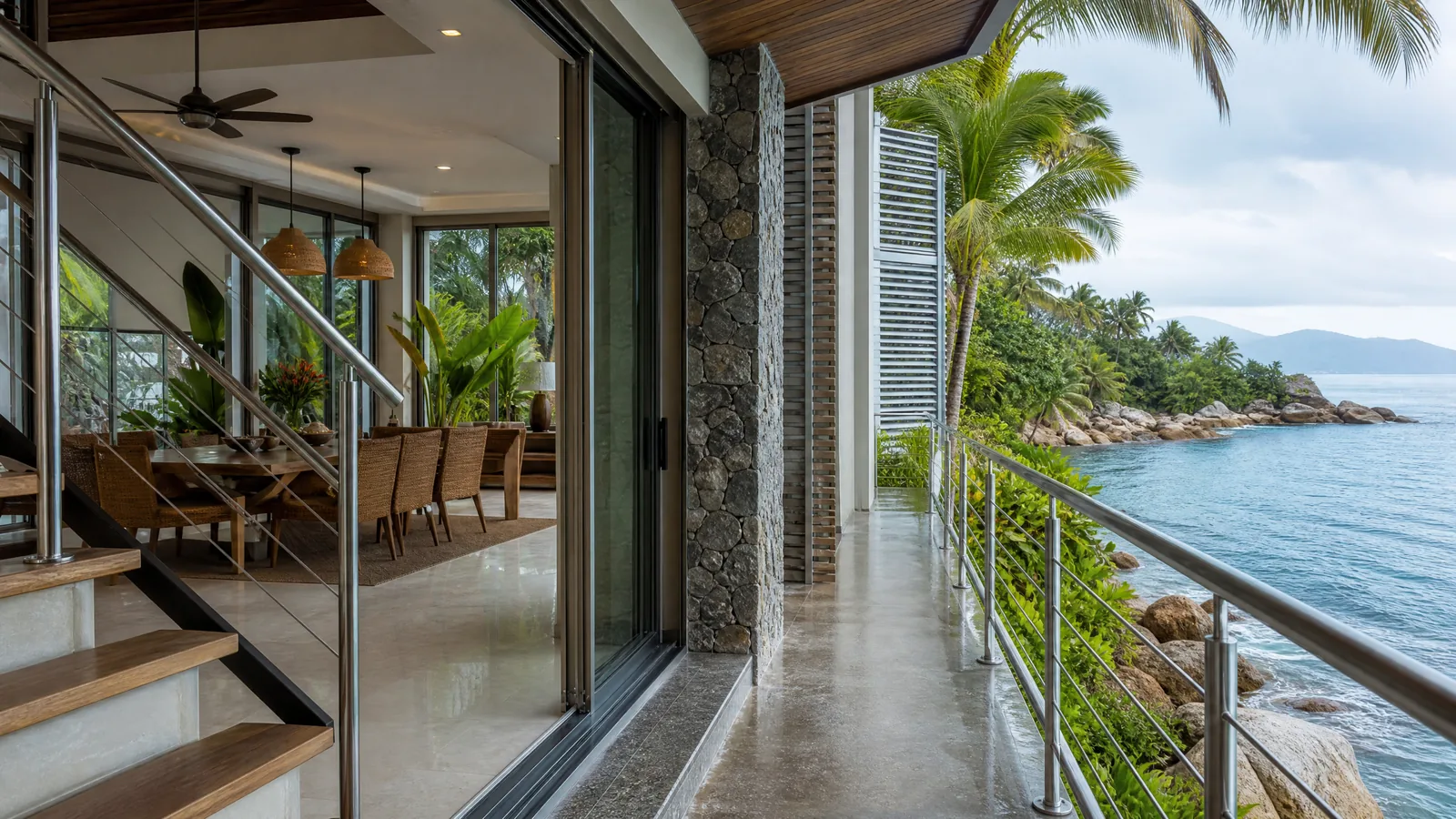
For humid, coastal Southeast Asia, specify 316L for exterior zones exposed to salt, pools, or industrial chlorides; choose 304 for interiors and sheltered areas. Prioritize smooth finishes, thoughtful detailing, and regular cleaning to limit tea staining. If in doubt or mixing environments, step up to 316L for critical exteriors and keep 304 for protected interiors.
Southeast Asia’s humidity, chlorides and stainless behavior
High humidity, frequent rainfall, and chloride-bearing atmospheres near the sea or pools challenge stainless steels across Malaysia, Indonesia, Thailand, the Philippines, Singapore, and Vietnam. Moisture plus chlorides can undermine the passive film that protects stainless surfaces, leading to tea staining or localized pitting if grade and finish are mismatched. Correct alloy selection, smooth finishes, and maintenance planning are the backbone of long-term performance in this climate.
Grade 304 is the workhorse for interiors and many sheltered environments. Grade 316L increases resistance to chloride-related attack thanks to added molybdenum and its low-carbon composition, which supports welding without sensitization issues. If your project sees wind-driven sea spray, pool chemicals, or de-icing salts (in cold storage logistics), 316L is typically the safer exterior choice.
For a broader look at common stainless families and naming, see our internal guide on stainless steel grade comparison, and consult industry resources such as World Stainless and the Nickel Institute.
304 vs 316L at a glance
The table below summarizes practical differences for humid and chloride-prone sites in Southeast Asia.
| Criterion | Grade 304 | Grade 316L |
|---|---|---|
| Typical composition | Approx. 18Cr–8Ni; no molybdenum. | Adds molybdenum (~2–3%) and low carbon for welding. |
| Humidity and coastal exposure | Good in interiors and sheltered exteriors; may tea-stain in salt-laden air. | Enhanced resistance to chloride-induced pitting and crevice attack in marine and pool atmospheres. |
| Weldability and fabrication | Formable and weldable; use proper procedures to avoid sensitization. | Low-carbon grade supports welding with reduced risk of sensitization; formable and weldable. |
| Recommended uses | Interior cladding, handrails, lift cabins, furniture, and sheltered canopies. | Coastal façades, pool enclosures, canopies exposed to sea spray, and marine-adjacent public spaces. |
| Finish guidance | Smoother finishes (e.g., mirror 8K) reduce staining; fine hairline usable with cleaning plan. | Smooth finishes also preferred; 316L tolerates harsher exposure with routine cleaning. |
| Maintenance cadence | Freshwater rinsing and neutral cleaners recommended in any salt or chemical exposure. | Still requires cleaning; typically more forgiving in chloride-prone settings. |
| Relative material cost | Standard benchmark for many projects. | Generally higher; selected to mitigate risk in aggressive environments. |
| WJH supply range | Decorative sheets and tubes across mirror, hairline, PVD, etched, and embossed finishes. | Available in the same decorative families for robust exterior aesthetics. |
Browse our full product range and grade-specific surface options including mirror 8K stainless steel sheets and hairline stainless steel.
When 304 is the right choice
Typical architectural uses
Grade 304 remains the go-to for most interior and conditioned-space applications in Southeast Asia: wall and ceiling cladding, elevator cabins, handrails, retail fixtures, and food service equipment. In covered transit nodes, shopping centers, and office lobbies, 304 balances appearance, formability, and broad availability.
Specification and detailing tips
- Prefer smooth, low-roughness surfaces to reduce dirt and chloride retention. Mirror 8K is highly effective indoors for a premium look and easier cleaning.
- For brushed aesthetics, select fine hairline/No.4 and include a routine cleaning plan, especially where doors open frequently to humid outdoor air.
- Use proper drainage and avoid ledges or crevices that trap condensate or airborne salts.
- If portions of a 304 installation face intermittent salt spray or pool chemicals, consider upgrading those zones to 316L to standardize maintenance.
When 316L is the right choice
Chloride-prone environments
Specify 316L for exteriors near coastlines, seafront promenades, marina facilities, ferry terminals, beachfront resorts, and pool decks. The molybdenum addition improves resistance to localized attack when airborne salts or chlorinated water are present. 316L is also a prudent choice for equipment and panels washed with chloride-containing cleaners.
Fabrication and welding notes
- 316L’s low carbon mitigates sensitization during welding. Use compatible filler metals and clean welds thoroughly.
- Post-fabrication cleaning and passivation help restore corrosion resistance at heat-affected zones.
- Avoid cross-contamination from carbon steel tools; use dedicated stainless tooling and handling.
For tubular handrails, balustrades, and canopy frames exposed to marine air, consider our stainless steel tubes in 316L. For complex assemblies, WJH provides OEM and custom fabrication support to align grade, finish, and fabrication method.
Finishes and surface quality to reduce tea staining
Tea staining is a cosmetic brown discoloration that can occur in chloride-bearing environments. It is not a structural failure but signals that the surface is retaining contaminants. Surface choice and maintenance greatly influence outcomes:
- Smooth, low-roughness finishes such as mirror 8K tend to shed contaminants more readily. See WJH’s mirror 8K sheets for premium interior and selected exterior features.
- Fine hairline or No.4 finishes provide directional texture; specify appropriate grain and plan for periodic cleaning. Explore WJH’s hairline stainless steel options.
- PVD color coatings add design impact and a hard ceramic-like surface layer. Color is aesthetic; base grade still governs corrosion resistance.
- Protect surfaces during construction. Remove chlorides and cement dust promptly and avoid abrasive cleaning pads that raise roughness.
For technical background on stainless steel and corrosion mechanisms, industry resources from World Stainless and the Nickel Institute are helpful references when developing maintenance plans.
Decision framework and sample specification
Practical choice flow
- Is the installation indoors or in an air-conditioned, low-chloride environment? 304 usually fits; use smooth finishes.
- Is the installation outdoors with regular exposure to sea breeze, pool water, or de-icing/cleaning salts? Favor 316L.
- Is the area a mix of sheltered and exposed zones? Use 316L for exposed components and 304 for protected interiors to optimize cost and maintenance.
- Are fine crevices, tight joints, or dense textures unavoidable? Step up finish smoothness and cleaning frequency; where risk remains, choose 316L.
Sample, non-project-specific specification wording
The following generic language can be adapted by your designer or consultant:
“Provide austenitic stainless steel components for architectural works as scheduled. Select grade based on exposure: use 316L for exterior elements subject to salt, pool chemicals, or industrial chlorides; use 304 for interior and sheltered elements. Surfaces shall be smooth and cleanable; mirror or fine-brush finishes acceptable as indicated. Apply good fabrication practice, clean and passivate post-weld. Provide protective films during transport and installation. Submit data sheets confirming grade, finish, and maintenance recommendations.”
For more on how grades compare across common standards, see our internal stainless steel grade comparison.
What to include in your RFQ
Clear RFQs help us deliver the right material quickly. Please include:
- Grade and application environment (304 interior, 316L coastal exterior, poolside, industrial, etc.).
- Product type (decorative sheet, tube, profile, fabricated assembly).
- Dimensions and thickness; drawing references for formed or fabricated parts.
- Surface finish and color (mirror 8K, hairline/No.4, PVD color, etched, embossed) and any anti-fingerprint requirement.
- Edge condition, film protection, and directional-grain orientation if applicable.
- Fabrication notes (bending radii, welding requirements, perforations, cut-outs) and tolerance targets.
- Quantity by item, delivery window, and destination port/site.
- Inspection or documentation requirements (material certificates, finish samples, packing method).
WJH Stainless Steel (Foshan Wanjiahong Stainless Steel Co., Ltd.), founded in 1996, operates marketing from Foshan, Guangdong, and a production base in Taishan exceeding 100,000 square metres with 600+ employees. Our facilities are certified to ISO 9001, ISO 14001, and ISO 45001, and we offer one-stop supply from decorative sheets and tubes to custom fabrication. Start with our product catalog or contact our team to align grade, finish, and fabrication with your site conditions.
Frequently Asked Questions
Is 304 acceptable outdoors in Southeast Asia?
Yes, for sheltered exteriors away from persistent salt spray or pool chemicals. In marine or poolside exposure, 316L is the more reliable choice.
Does 316L completely prevent rust or tea staining?
No grade is maintenance-free. 316L resists chloride attack better than 304, but regular cleaning and good detailing are still required.
Which finishes are least prone to tea staining?
Smoother surfaces such as mirror 8K are easier to keep clean. Directional brushed finishes can perform well with a documented cleaning schedule.
Can I mix 304 and 316L on the same project?
Yes. Many projects use 316L for exposed exteriors and 304 for protected interiors to balance performance and cost.
Do PVD colors change corrosion resistance?
PVD color adds a hard decorative layer, but the base alloy still determines corrosion resistance. Choose 316L for aggressive exterior exposures.
Ready to specify material that matches your site conditions? Send your grade, size, finish, quantity, destination, and any drawings to our team via the contact page. We will help align 304 or 316L with appropriate finishes and fabrication for your project.