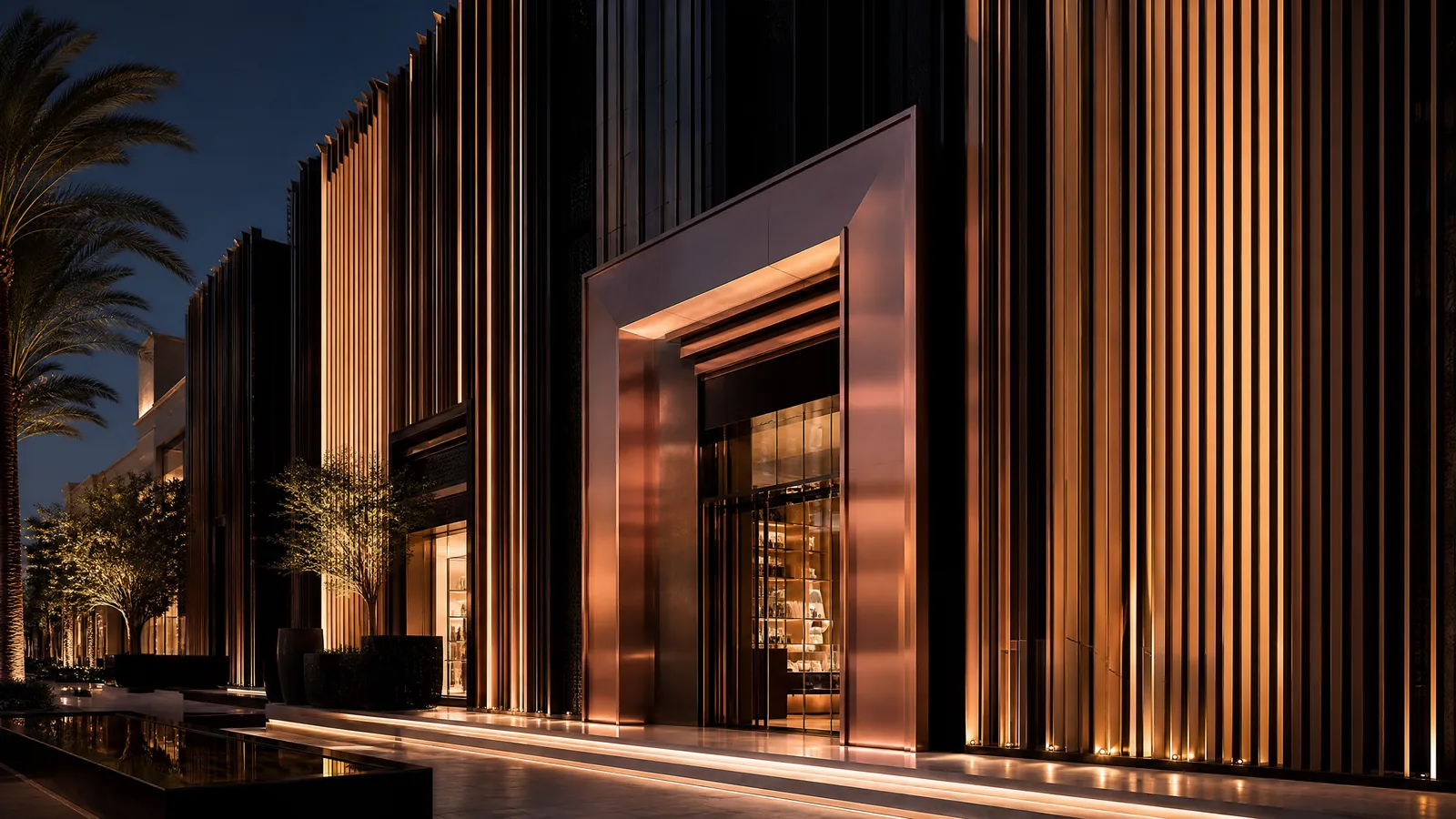
PVD colored stainless steel delivers the premium look Middle East projects demand for heat, humidity and airborne-sand conditions when correctly specified—provided you match the substrate grade to the environment, understand coating limits, plan mock‑ups, and specify cleaning from day one.
Why PVD Color Stainless Steel Fits Middle East Projects
In Gulf cities, materials must combine opulent aesthetics with resilience to temperature swings, saline air and wind‑borne dust. Physical Vapor Deposition (PVD) creates a thin, hard, color layer on stainless steel through vacuum deposition. The result is a metallic color that retains the underlying stainless character and can provide a durable decorative surface when correctly specified and maintained. For hotel lobbies, retail frontages, towers, transit hubs and premium residences from Dubai to Riyadh, PVD stainless helps achieve signature gold, bronze, champagne, black and custom tones across flat sheets, profiles and fabricated features.
WJH Stainless Steel (Foshan Wanjiahong), founded in 1996, integrates decorative sheet production with custom fabrication. With ISO 9001, ISO 14001 and ISO 45001 certifications, a production base exceeding 100,000 square metres in Taishan and marketing in Foshan, our team can support Middle East project requirements from finish selection through prototyping and packaging. Explore core products including PVD color coating stainless steel, mirror 8K sheets, hairline/No.4 finishes, and OEM custom fabrication.
Interior vs Exterior: Performance Considerations
Interior zones
For high‑traffic interiors—lobbies, lift cars, corridor cladding, feature walls—PVD offers a rich, uniform color with good scuff resistance. Combine with anti‑fingerprint (AFP) treatment to reduce smudges on touchpoints such as door trims and handrails. Directional base finishes (hairline/No.4) help disguise minor abrasion along the grain in service areas, while mirror 8K amplifies light in signature spaces.
Exterior zones
On façades, soffits, canopies and screens, the substrate grade selection becomes critical due to humidity, saline exposure, and cleaning practices. PVD’s decorative layer enhances surface hardness; however, overall corrosion performance is governed by the underlying stainless grade and the environment. Match grade to exposure, detail for drainage, and specify compatible cleaners. On sun‑exposed assemblies, account for thermal movement with appropriate joints and fixings.
Selecting the Right Stainless Steel Grade
Choose the stainless substrate for corrosion resistance first, then select the PVD color and texture. General guidance for the region:
- Interior dry areas: austenitic grades commonly specified for decorative use, selected per budget and expected wear.
- Exterior inland urban sites with routine cleaning: widely used architectural grades; select finish and detailing to shed contaminants.
- Coastal, marine or pool‑adjacent zones: higher corrosion‑resistance grades are typically preferred; specify conservative details and cleaning regimes.
For comparative composition and typical uses of common grades, see WJH’s stainless steel grade comparison. Industry background on stainless steel families is available from the Nickel Institute. Always align grade selection with local codes, environment and maintenance capability.
PVD Coating Realities You Must Plan For
PVD color is robust for architectural use, but it is not immune to misuse. Planning for these realities avoids rework:
- Forming limits: Deep draws or tight bends after coating can stress the color layer. Complex fabrication is typically performed before PVD coating, with tight bend radii reviewed during engineering.
- Welding and heat: Localized heat can affect color. Where welding is required, plan for post‑process finishing or design joints to conceal heat‑affected zones.
- Backside and edges: Standard PVD addresses the exposed face. If edge visibility is critical, specify edge finishing requirements.
- Batch color variation: Like all metallic finishes, slight shade variation can occur between production lots. Order by area with spares, and install panels in sequence.
- Chemical compatibility: Avoid chloride‑bearing or abrasive cleaners. Specify pH‑neutral products and rinse thoroughly.
- Glazing and sealants: Confirm sealant, adhesive and protection‑film compatibility with stainless/PVD to prevent staining.
Finishes, Textures and Anti‑Fingerprint Options
The perceived depth and serviceability of PVD are strongly influenced by the base finish and texture:
- Mirror 8K base: Maximizes reflectivity and color saturation for statement walls, columns and luxury retail—see mirror 8K stainless steel sheet.
- Hairline/No.4 base: A fine linear grain that diffuses reflections and helps conceal incidental scuffs—see hairline stainless steel.
- Etched and embossed accents: Combine PVD color with selective etching or embossing for patterned feature panels; explore custom fabrication options for integrated screens, trims and profiles.
- AFP (anti‑fingerprint): A clear top treatment that reduces fingerprints and eases cleaning on touchable surfaces.
Popular Middle East palettes include gold, rose gold, bronze/champagne and black/graphite. Specify the reference color and texture using approved samples and project mock‑ups.
Fabrication, Installation and Maintenance Essentials
Fabrication and handling
- Sequence: For profiles and complex panels, fabricate first, then apply PVD to the completed part when feasible.
- Directionality: Install directional finishes with consistent grain orientation across each elevation.
- Protection: Use compatible protective films during transport and fit‑out; remove promptly after installation.
- Fasteners and subframes: Use corrosion‑resistant, compatible metals to avoid galvanic staining. Design for ventilation and drainage.
Mock‑ups and approvals
- Produce a representative on‑site or off‑site mock‑up covering panel joints, corner details, lighting conditions and cleaning trials.
- Approve color, gloss, grain direction, edge finishing and maintenance method before area production.
Maintenance planning
- Routine cleaning: Remove dust with a soft cloth or low‑pressure water, then wash with a pH‑neutral detergent; rinse and dry to avoid water marks.
- Cleaning frequency: Increase frequency for coastal façades and wind‑exposed elevations.
- Avoid: Abrasive pads, bleach/chloride cleaners and untested chemicals. Test any new product on a concealed area.
For general stainless steel care and corrosion considerations, consult industry sources such as World Stainless. Align maintenance with local conditions and access methods.
Specification Guide and Decision Table
Use the following matrix to align application, grade, finish and fabrication approach. Confirm all selections with your façade or interiors consultant and your supplier’s production team.
| Project zone | Application example | Recommended substrate focus | Base finish | Color/texture notes | Fabrication approach | Joining/installation | Maintenance emphasis |
|---|---|---|---|---|---|---|---|
| Interior dry, public | Lift cars, lobby walls, columns | Decorative austenitic grade suited to traffic level | Mirror 8K or hairline/No.4 | Gold, bronze, black; AFP recommended on touchpoints | Form first, PVD after for complex shapes | Concealed fixings; protect surfaces during fit‑out | Regular dust removal and pH‑neutral wipe‑downs |
| Exterior inland façade | Rainscreen, soffits, fins | Common architectural austenitic grades; detail for drainage | Hairline/No.4 for diffuse appearance | Order by elevation/lot; coordinate grain direction | Panelize; maintain generous bend radii | Rivets/clips in compatible alloys; allow movement | Scheduled rinsing and gentle wash cycles |
| Coastal or pool‑adjacent | Canopies, balustrade infill, cladding | Higher corrosion‑resistance austenitic grades | Hairline/No.4 or textured to mask deposits | Prefer AFP; avoid crevices and water traps | Tight QA on edges and backs; sealant compatibility checks | Mechanically fixed, ventilated assemblies | More frequent fresh‑water rinsing and inspection |
| Retail/hospitality features | Counter fronts, screens, trims | Decorative austenitic grades matched to use class | Mirror 8K for highlights; etched/embossed for accent | Custom patterns and logo treatments | Precision fabrication before coating as needed | Adhesive bonding or concealed mechanical fixings | AFP for touch areas; routine fingerprint removal |
What to Include in Your RFQ or Project Specification
Clear information accelerates sampling, pricing and production planning. Include:
- Application and environment: interior/exterior; inland/coastal; target cleaning frequency.
- Stainless steel grade requirement and thickness (if defined) or performance criteria leading the grade choice.
- Base finish (mirror 8K, hairline/No.4, etc.), color reference and whether AFP is required.
- Panel dimensions, tolerances, and edge visibility; indicate if edges/back require finishing.
- Fabrication scope: flat sheets supply, profiles, perforation, etching/embossing, welding, or complete assemblies.
- Forming details: minimum bend radii, corner treatments, perforation patterns, and joint design.
- Installation method and interface materials (subframes, fasteners, adhesives, sealants) for compatibility review.
- Mock‑up expectations: size, components and approval criteria.
- Packing, labeling and site protection needs.
- Destination port/city and any special documentation. For management system references, WJH holds ISO 9001/14001/45001 certifications (see ISO).
For end‑to‑end support from finish selection to fabrication, see our PVD color stainless offerings and custom fabrication services, or browse related decorative stainless products. For regional project context, view selected project experience and answers on our FAQ page.
Frequently Asked Questions
Is PVD color suitable for exterior façades in the Middle East?
Yes, when paired with an appropriate stainless grade, good detailing and a realistic cleaning plan. The substrate—not the color alone—governs corrosion resistance.
Can PVD panels be bent or formed?
Simple bends are feasible with planning, but tight radii or deep draws after coating risk color damage. Complex parts are typically fabricated first, then coated.
Will fingerprints be a problem on darker colors?
Darker tones can show smudges in touch areas. Specify anti‑fingerprint treatment and a pH‑neutral cleaning routine to minimize visible marks.
How do I manage color consistency across large areas?
Approve control samples, procure by elevation from a single batch with overage, and install panels in sequence, maintaining grain orientation where applicable.
Can PVD be repaired on site if scratched?
Minor scuffs on directional finishes may be less visible. Localized color repair is limited; replacement of the affected panel is the typical solution.
Ready to move forward? Share your grade, size, base finish, color, quantity, destination and drawings so our engineering team can advise on samples and manufacturability. Contact WJH at wjhsteel.com/contact.